Influencer marketing has evolved from experimental brand collaborations into a structured performance channel. However, even today, many influencer campaigns underperform — not because of poor creators, but because of unclear direction.
For brand managers, this creates multiple risks:
- Budget inefficiency
- Brand misrepresentation
- Compliance issues
- Delayed execution
- Unpredictable performance
An influencer briefing eliminates these risks by providing structured alignment between your brand and the creator.
A well-crafted influencer briefing ensures:
- Strategic clarity
- Creative alignment
- Legal protection
- Measurable ROI
- Operational efficiency
- Find Right Influencers
This guide explains how to build influencer briefings that are performance-driven, scalable, and creator-friendly.
What Is an Influencer Briefing?
An influencer briefing is a structured campaign document that communicates your brand’s objectives, messaging framework, creative expectations, compliance rules, deliverables, and performance metrics to an influencer before content production begins.
It acts as:
- A strategic alignment tool
- A creative direction guide
- A performance expectation document
- A risk management framework
Unlike an influencer contract, which is legally binding, the influencer briefing focuses on execution clarity and campaign alignment.
Think of it as the blueprint of your influencer campaign. Without it, you are relying on assumptions.
Why Influencer Briefing Matters for Brand Managers
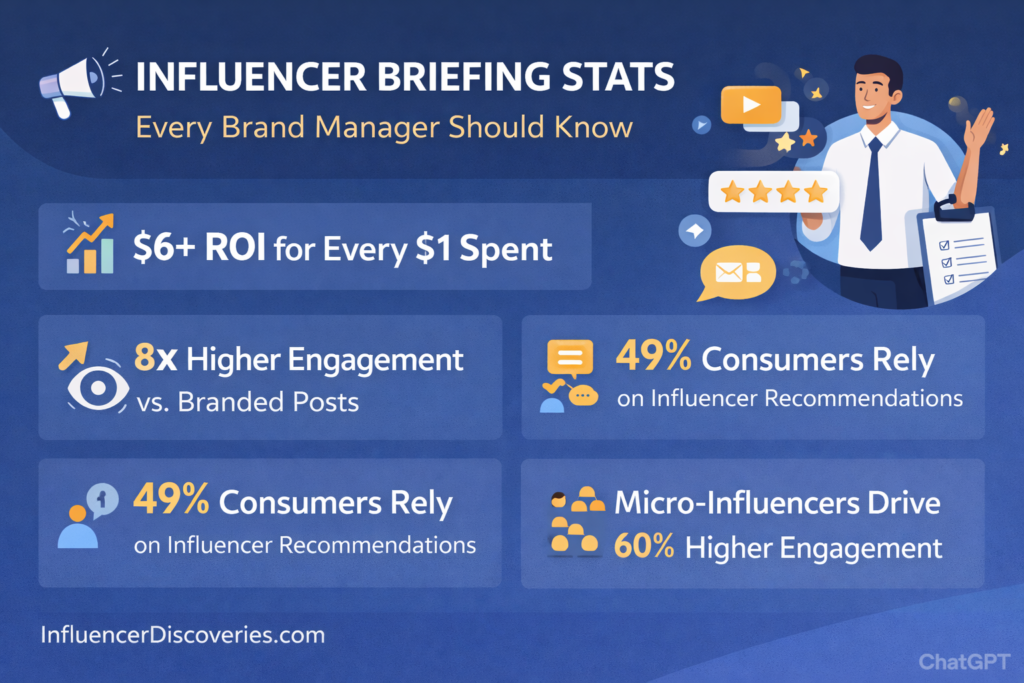
From a brand management perspective, influencer briefings directly impact business performance.
1. Protects Brand Positioning
Every influencer has their own voice. Without guidance, messaging may drift away from your brand’s positioning, tone, or values.
A briefing ensures:
- Brand consistency across creators
- Controlled messaging hierarchy
- Clear value proposition communication
2. Reduces Operational Friction
Ambiguity leads to revisions. Revisions lead to delays. Delays increase campaign costs.
Clear briefings reduce:
- Back-and-forth communication
- Re-edit requests
- Internal approval cycles
3. Improves ROI Predictability
When KPIs, objectives, and audience targeting are defined in advance, campaign outcomes become measurable and repeatable.
4. Ensures Compliance & Risk Mitigation
Disclosure requirements (#ad, sponsored tags), product claims, and industry regulations must be clearly communicated to avoid legal exposure.
Who Should Create the Influencer Brief
In mature organizations, influencer briefings are collaborative documents.
1. Brand Manager
Defines:
- Campaign objective
- Brand positioning
- Core messaging
2. Marketing Manager
Defines:
- KPIs
- Budget structure
- ROI expectations
3. Social Media Lead
Defines:
- Platform-specific guidelines
- Content format
- Engagement style
4. Legal Team
Defines:
- Disclosure requirements
- Usage rights
- Industry compliance
In startups or smaller teams, the brand manager often consolidates all these roles.
What You Need to Tell Influencers About Your Project
This section forms the foundation of your influencer briefing.
1. Campaign Objective (Strategic Clarity)
Every briefing must start with one primary objective.
Common objectives:
- Brand awareness
- Product launch visibility
- Lead generation
- App installs
- Website traffic
- Direct sales
- Affiliate revenue
Be specific.
Instead of:
“Increase awareness”
Say:
“Drive 20,000 qualified impressions among 25–35-year-old urban professionals in 30 days.”
Clear objectives shape better content.
2. Target Audience (Performance Alignment)
Influencers know their audience — but you must define yours.
Include:
- Age range
- Geographic focus
- Income level (if relevant)
- Interests
- Purchase intent
- Pain points
When influencers understand your target customer, they can naturally tailor their storytelling.
3. Deliverables (Operational Clarity)
This prevents confusion later.
Define:
- Platform(s)
- Number of posts
- Content format (Reel, Story, YouTube integration, etc.)
- Duration (30-sec mention vs 5-min demo)
- Posting schedule
- Draft submission timeline
Also clarify:
- How many revision rounds are allowed
- Approval turnaround time
4. Key Messaging (Strategic Direction)
Provide a structured message hierarchy:
Primary Message:
Your core value proposition.
Supporting Points:
3–5 benefit-focused talking points.
Proof Elements:
Statistics, testimonials, or claims (if compliant).
Mandatory Inclusions:
- Hashtags
- Brand tags
- Call-to-action
- Tracking links
Avoid overloading the creator with rigid scripts. Provide direction, not dictation.
5. Creative & Brand Guidelines (Identity Protection)
Influencers need freedom — but within brand boundaries.
Clarify:
- Tone of voice (educational, bold, playful)
- Visual aesthetics (minimal, vibrant, luxury)
- Logo placement rules
- Product handling guidelines
- Competitor restrictions
The goal is to maintain brand identity without restricting authenticity.
6. Compliance & Disclosure (Risk Management)
Influencer campaigns are regulated.
Include:
- Required hashtags (#ad, #sponsored)
- Paid partnership tools
- Industry-specific legal disclaimers
- Claim restrictions
- Country-specific guidelines
Compliance clarity protects brand reputation.
7. Performance Expectations & KPIs (ROI Accountability)
Share measurable expectations.
For awareness campaigns:
- Impressions
- Reach
- Engagement rate
For performance campaigns:
- Click-through rate
- Conversion rate
- Cost per acquisition
- Sales volume
Also define:
- Tracking method
- Reporting format
- Performance review timeline
Influencer Brief Examples
1. Product Launch Influencer Brief – Example: Glossier
Campaign Type: New product launch
Focus: Product education + aesthetic storytelling
Typical Brief Elements:
- Product benefits & ingredients
- Visual mood board (soft, minimal aesthetic)
- Mandatory product demo
- Launch date embargo
- Hashtags + brand tag
- Swipe-up link with UTM tracking
Why it works:
Glossier-style briefs balance brand identity with creator authenticity, giving structure without over-scripting.
2. Performance / Affiliate Brief – Example: Gymshark
Campaign Type: Sales-driven campaign
Focus: Conversions & discount codes
Typical Brief Elements:
- Unique promo code per influencer
- Clear CTA: “Shop using code X”
- Highlight product fit & comfort
- Minimum story mentions
- Sales tracking dashboard access
Why it works:
Performance briefs clearly define revenue expectations and simplify tracking.
3. Brand Awareness Brief – Example: Airbnb
Campaign Type: Experience storytelling
Focus: Lifestyle-driven content
Typical Brief Elements:
- Story-first narrative guidance
- Showcase real travel experience
- Soft CTA (Explore more)
- High-quality visuals required
- Location tagging
Why it works:
The brief prioritizes emotional storytelling over hard selling.
4. Tech Product Demo Brief – Example: Samsung
Campaign Type: Feature promotion
Focus: Product demonstration
Typical Brief Elements:
- Must-show product features
- Comparison points vs older model
- Demo format requirements
- Clear benefit explanation
- FTC disclosure clarity
Why it works:
Highly structured but still allows influencer style in delivery.
5. UGC-Focused Brief – Example: Sephora
Campaign Type: User-generated content for ads
Focus: Repurposable creative assets
Typical Brief Elements:
- Vertical 9:16 format required
- Raw footage submission
- Hook within first 3 seconds
- Paid ads usage rights included
- 30–90 day usage permission
Why it works:
Designed for scalability and paid media reuse.
What Makes These Influencer Brief Examples Strong?
Across industries, effective influencer brief examples share:
- Clear campaign objective
- Structured deliverables
- Defined KPIs
- Compliance clarity
- Creative flexibility
- Measurable performance expectations
Influencer Briefing Checklist for Brand Managers
Before sending your briefing, confirm:
✔ Objective defined
✔ Audience specified
✔ Deliverables detailed
✔ Messaging aligned
✔ Creative guidelines included
✔ Disclosure requirements added
✔ KPIs clarified
✔ Payment structure confirmed
✔ Usage rights defined
✔ Approval workflow documented
This checklist ensures nothing is overlooked.
Influencer Brief Template
Below is a professional framework you can use:
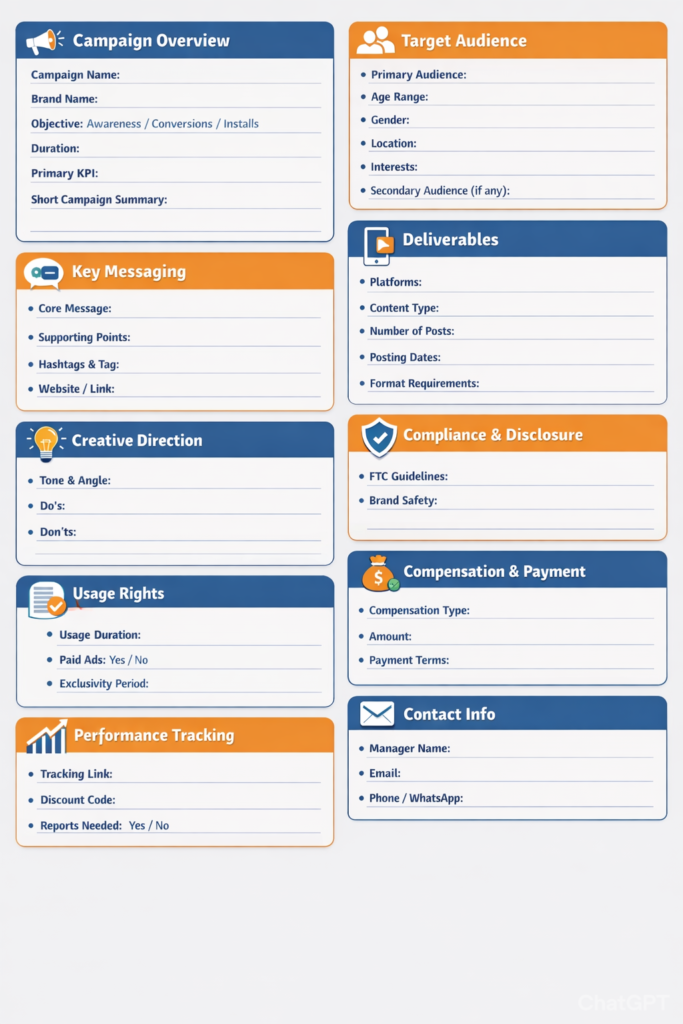
This format is scalable for both single campaigns and multi-influencer programs.
Influencer Briefing vs Influencer Contract
These are complementary but different.
| Influencer Briefing | Influencer Contract |
|---|---|
| Strategic guidance | Legal agreement |
| Messaging & deliverables | Payment terms |
| Campaign KPIs | Liability clauses |
| Creative alignment | Legal protection |
Both are necessary for structured influencer marketing strategy.
Common Mistakes Brand Managers Should Avoid
- Overloading with 15+ talking points
- Providing the brief too late
- Ignoring creator feedback
- Not defining revision limits
- Vague KPIs
- No clarity on content rights
- Micromanaging creative direction
Remember: Collaboration improves authenticity.
KPIs to Evaluate the Effectiveness of Your Brief
Evaluate not only results, but execution efficiency:
- Revision frequency
- Approval turnaround time
- Content alignment rate
- Engagement quality
- Conversion efficiency
- Cost per result
If you consistently need heavy revisions, your brief lacks clarity.
Tools to Create & Manage Influencer Briefings
1. Documentation Tools
Google Docs – Collaborative editing
Notion – Organized campaign management
2. Creative Tools
Canva – Visual brand references
3. Influencer Management Platforms
- Aspire
- Upfluence
- CreatorIQ
These tools help standardize influencer workflows at scale.
Workflow: From Brief to Campaign Execution
- Define objective
- Identify relevant influencers
- Draft influencer briefing
- Internal review & approval
- Share with influencer
- Align & finalize
- Execute campaign
- Track performance
- Analyze ROI
- Optimize future briefings
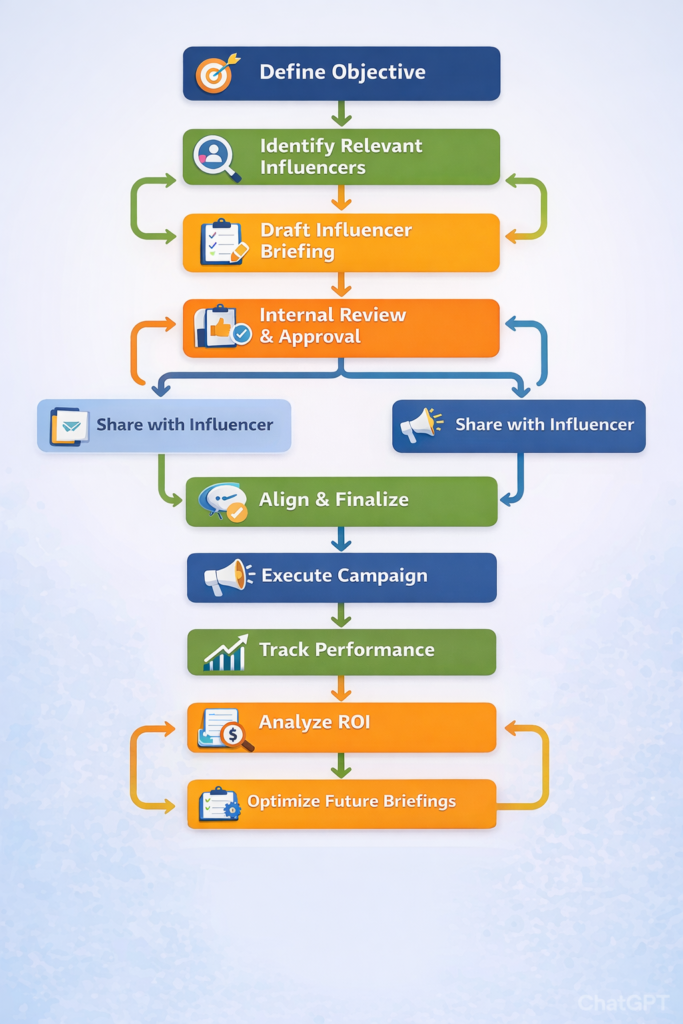
Structured workflow reduces campaign unpredictability.
Conclusion
An influencer briefing is not just a document — it is a strategic control system for influencer marketing.
For brand managers, it:
- Protects brand identity
- Reduces operational friction
- Improves performance predictability
- Enhances influencer collaboration
- Strengthens ROI measurement
When executed properly, influencer briefings transform influencer campaigns from creative experiments into structured performance marketing programs.